# parkring 1.0: Concurrency Primitives I Tried Hard to Break
Oct 2026 · 20 min read · Rust, Concurrency

How a small Rust queue that passed all its tests (and was still wrong) became parkring 1.0: channels, lock-free queues, a work-stealing deque and a thread pool, checked with loom, Miri, fuzzing and ThreadSanitizer.

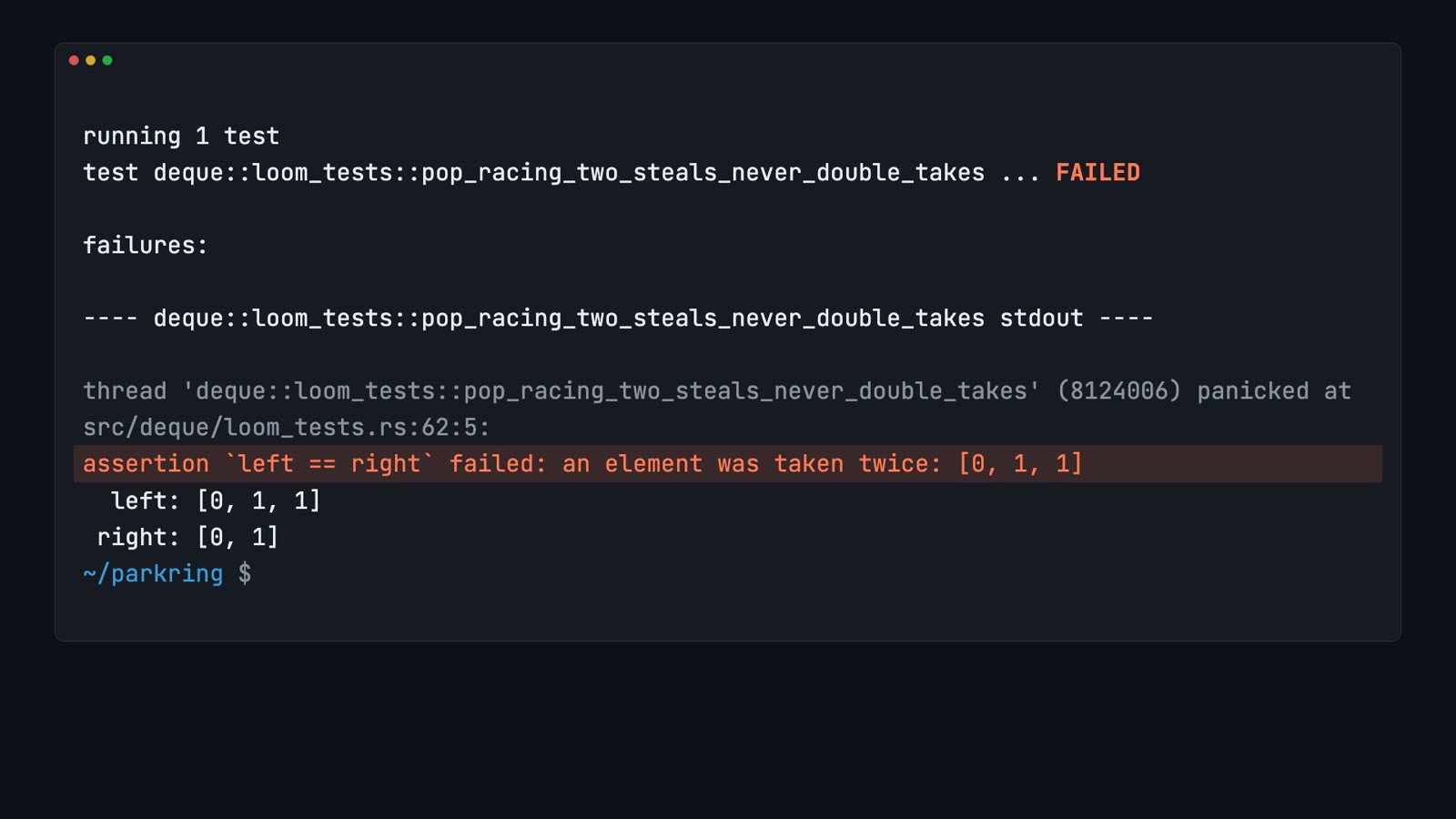
![loom catching a double take in a deliberately broken work-stealing deque](/blog/parkring-1-0-cover.jpeg)

> parkring is a Rust crate with bounded channels and queues, a work-stealing deque and a work-stealing thread pool. It started as one small queue that passed all its tests and was still wrong. This post is how it got to 1.0: what each piece does, how it works, and what the tools found along the way, including a hole in a published paper's algorithm.

> Code, design notes and every benchmark: [github.com/anmol0b/parkring](https://github.com/anmol0b/parkring). Docs: [docs.rs/parkring](https://docs.rs/parkring).

## Introduction:-

Let's start with a simple question:

**How do you know concurrent code is correct?**

With normal code, you write tests, they pass, and you move on.  
With concurrent code, a test can pass ten thousand times and fail on run ten thousand and one. Or only on a different CPU. Or only when the OS pauses a thread at exactly the wrong instruction.

My first queue passed every test I wrote for it. It still lost items, reported "full" when it wasn't, and burned a CPU core while doing nothing.

This post is about what I built after that, and more importantly **how I checked it**:

- what a bounded MPMC queue is, and the two classic ways to build one
- how threads wait without wasting a core
- channels, a work-stealing deque and a thread pool on top
- the tools that found real bugs, and the bugs they found
- benchmarks, including the ones where I lose

The goal is simple:

**make every bug something a tool catches, not something luck catches.**

```sh
cargo add parkring
```

## What's in the box :-

This is the part most people will use, a bounded channel between threads:

```rust
use std::thread;
use parkring::channel;

let (tx, rx) = channel::bounded(64);

// Four producers, each with its own clone of the sender.
let producers: Vec<_> = (0..4u64)
    .map(|id| {
        let tx = tx.clone();
        thread::spawn(move || {
            for i in 0..1_000 {
                tx.send(id * 1_000 + i).unwrap(); // sleeps while the channel is full
            }
        })
    })
    .collect();
drop(tx); // only the producers' clones keep the channel open now

// `iter()` ends once all senders are gone and the channel is empty.
let total: u64 = rx.iter().sum();
assert_eq!(total, (0..4_000).sum());
for p in producers {
    p.join().unwrap();
}
```

Under it sit the pieces that do the real work:

| type | what it is | based on |
|---|---|---|
| `channel::bounded` | MPMC channel, disconnects when one side is dropped | |
| `LockFreeQueue` | bounded MPMC queue, spins then sleeps | Vyukov |
| `ScqQueue` | bounded MPMC queue with a lock-free guarantee (64-bit) | Nikolaev, DISC 2019 |
| `BlockingQueue` | a mutex and two condvars, the reference everything is tested against | |
| `Worker` / `Stealer` | Chase-Lev work-stealing deque | Lê et al., PPoPP 2013 |
| `ThreadPool`, `join` | fork-join pool built on the deque | |

The only dependency is `libc`. A thread that has to wait sleeps in the kernel, so an idle program uses no CPU.

## The Problem: Many Threads, One Queue

Picture a web server. Some threads accept requests, others process them.

The accepting threads need somewhere to put work.  
The processing threads need somewhere to take it from.

That place is a **queue**, and because many threads put work in and many take it out, it's a **multi-producer, multi-consumer (MPMC)** queue.

```text
producer 1 ──┐                      ┌──▶ consumer 1
producer 2 ──┼──▶ [ bounded queue ] ┤
producer 3 ──┘                      └──▶ consumer 2
```

It should be **bounded**: it holds at most N items, and when it's full, producers wait.

> That isn't a limitation, it's the point.

A bounded queue gives you **backpressure**. If consumers fall behind, producers slow down instead of filling memory until the process dies.

So the job is: a fixed-size buffer that many threads can push to and pop from at once, without losing items, without duplicating them, in FIFO order, and fast.

## The Obvious Answer: A Lock

The simplest correct version is a ring buffer behind a mutex, with two condition variables: one wakes producers when space frees up, the other wakes consumers when an item arrives.

```rust
pub fn push(&self, item: T) {
    let mut ring = self.lock.lock().unwrap();
    while ring.is_full() {
        ring = self.not_full.wait(ring).unwrap();   // sleep until a pop
    }
    ring.push(item);
    self.not_empty.notify_one();                     // wake a consumer
}
```

That's `BlockingQueue`, and it's obviously correct.

Its problem is just as obvious: **every push and pop takes the same lock.**

With one producer and one consumer, that's fine. With eight of each, threads spend their time waiting for each other. At 4 producers and 4 consumers on a 16-slot queue, it manages about **1 million items a second**. The lock-free queue below does **19.5 million** on the same test.

## Without a Lock: Vyukov's Ring

Dmitry Vyukov's bounded MPMC queue removes the global lock.

The trick is a **sequence number in every slot**, which says which "turn" the slot is ready for.

```text
 positions:   0    1    2    3  | 4    5    6    7  | ...   (they only ever grow)
 slots:      [s0] [s1] [s2] [s3]  (position p lives in slot p % 4)

 slot.sequence == p      → empty, waiting for the producer of position p
 slot.sequence == p + 1  → full, waiting for the consumer of position p
 after the consumer      → sequence = p + 4: empty for the next lap
```

- A producer reads `tail`, checks that slot's sequence, and claims the position with one compare-and-swap.
- It writes the item, then **publishes** it by bumping the sequence.
- A consumer does the mirror image on `head`.

Producers and consumers working on different slots never touch the same memory, so they never wait for each other.

### Why memory ordering matters here

The CPU and the compiler are both allowed to reorder memory operations. So "write the item, then bump the sequence" is **not** automatically seen in that order by another core.

The bump is a **Release** store. The consumer's read is an **Acquire** load. Together they guarantee that a consumer who sees the new sequence also sees the item.

> The whole queue rests on that one pairing.

## My First Version, and What Was Wrong With It

My first version had both queues, a mutex one and a Vyukov one, a test suite that passed, and benchmarks. It was published as `bounded_mpmc_queue` 0.1.

When I came back to turn it into a real library, I audited my own code. It had real bugs.

### try_push failed when the queue wasn't full

Vyukov's algorithm compares the sequence with the position **three ways**:

- equal → claim it
- smaller → full
- larger → someone else got there first, reload and retry

My version treated anything other than equal, and any lost race, as "full":

```rust
Err(_) => return Err(item),   // lost a race: reported as full
...
} else {
    return Err(item);          // stale position: reported as full
}
```

Four threads pushing 8 items each into a 64-slot queue, which never held more than half its capacity, got **65 rejected pushes**. The blocking `push` only worked because it retried blindly.

### Capacities that weren't powers of two lost items

The README said capacity was rounded up to a power of two. The code didn't do that, but it indexed with `pos & (capacity - 1)`, which only works for powers of two.

A capacity-3 queue **accepted three pushes and then returned none of them.**

### Idle threads burned a core forever

A consumer waiting on an empty queue spun and yielded in a loop. It had no way to sleep and no way to be told the queue was shutting down.

### The benchmarks measured the wrong thing

Every timed iteration spawned up to 32 threads to move 100 items each. The numbers mostly measured `thread::spawn`.

All of these are fixed, each with a regression test that fails on the original code. Then I set out to make sure the **next** round of bugs would be caught by tools, not by luck.

## Waiting Without Burning a Core: Spin, Then Park

When a queue is empty, a consumer has two bad options:

- **spin**: reacts fast, wastes a whole core
- **sleep**: cheap, but slow to wake

parkring does both, in order: spin briefly (the item often arrives within microseconds), yield a few times, then **park**, which puts the thread to sleep in the kernel until someone wakes it.

### The lost wakeup

Parking is where concurrency bugs like to hide. The classic one:

```text
consumer                         producer
────────                         ────────
check queue: empty
                                 push item
                                 any sleepers? none yet, skip the wake
go to sleep
   ...sleeps forever, with an item in the queue
```

The fix is a careful protocol:

1. The consumer **registers** as a waiter, then **re-checks** the queue before sleeping.
2. The producer publishes the item, then checks for waiters.
3. The re-check is a read-modify-write on the same atomic the producer changes, so at least one of the two must see the other.

The gap between "re-checked" and "actually asleep" is closed by sleeping on a **futex**: the kernel only puts the thread to sleep if a word in memory still holds the value the thread last saw. If the producer changed it in between, the sleep doesn't happen.

parkring calls the kernel directly for this: `futex(2)` on Linux and `__ulock` on macOS, with a `Condvar` fallback everywhere else.

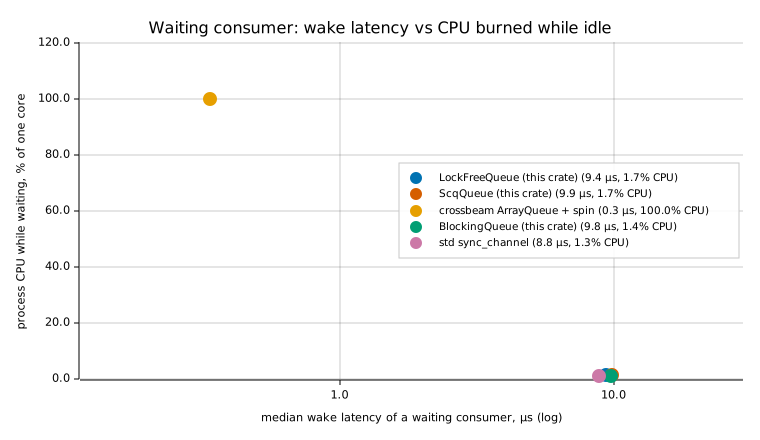
Measured with `getrusage`, a parked consumer uses **about 35 to 55 µs of CPU over 300 ms**. A spinning one uses all 300 ms.

![Wake latency against idle CPU](/blog/parkring/wake_latency.svg)

That chart is the trade-off in one picture. crossbeam's `ArrayQueue` has no blocking operation, so a waiting consumer has to spin: it notices a new item in **0.3 µs** but burns **100%** of a core. parkring wakes in about **9 µs**, the cost of a kernel wakeup, and uses **under 2%**, about the same as `std::sync::mpsc`.

## Channels: The Part You'll Actually Use

A shared queue with an explicit `close()` is a fine building block, but it puts shutdown on you. Somebody has to know when the last producer is done and call `close` exactly once.

Channels move that job to the type system. `channel::bounded(n)` returns a `Sender` and a `Receiver`, both cloneable, and the channel closes itself when the last handle on either side is dropped:

- Drop the **last `Sender`** → receivers still get every message that was sent. After that, `recv` returns `Err(RecvError)` and `iter()` ends.
- Drop the **last `Receiver`** → `send` fails at once and hands your message back inside `SendError`, so nothing is silently lost.

```rust
use parkring::channel::{self, TrySendError};

let (tx, rx) = channel::bounded(2);
tx.try_send("a").unwrap();
tx.try_send("b").unwrap();
assert_eq!(tx.try_send("c"), Err(TrySendError::Full("c"))); // full: nothing waits

assert_eq!(rx.recv(), Ok("a"));
drop(rx); // the only receiver
assert_eq!(tx.send("d").unwrap_err().into_inner(), "d"); // you get "d" back
```

Underneath, a channel is a `LockFreeQueue` plus two counters, one for live senders and one for live receivers. Whoever drops a count from one to zero closes the queue. The names (`try_send`, `recv_timeout`, `TryRecvError` and so on) follow `std::sync::mpsc` and `crossbeam-channel`, so it should feel familiar.

The tricky part is the race between the last sender dropping and a receiver going to sleep. If the receiver checks "anyone still sending?", then the sender drops and closes, and only then does the receiver park, it must still wake up.

> That's the same shape as the lost wakeup above, and it gets the same treatment.

loom models of the disconnect races run under both parkers, and a deliberately broken build that skips the close (`channel_no_disconnect`) must be caught by loom, or CI fails.

## How Do You Test This?

Concurrency bugs depend on timing, so parkring is checked by several tools, each blind in a different place.

### Ordinary tests, repeated

Every queue runs the same suite: FIFO order, exactly-once delivery across many producer and consumer counts, shutdown, timeouts. The concurrent tests run in loops, because rare schedules only show up under repetition.

### Property-based tests

**proptest** generates thousands of random operation sequences and checks each queue against an obviously correct model, Rust's `VecDeque`. When one fails, it **shrinks** the input to the smallest failing case.

### loom, a model checker

**loom** runs a test under every possible interleaving of its threads, up to a bound, and models the C++/Rust memory model, including which stale values a load is allowed to return.

> A loom test isn't "probably fine". Within its bound, it has tried every schedule.

### Miri, an interpreter for undefined behaviour

**Miri** runs the tests on an interpreter that checks every pointer, every read of possibly uninitialised memory, every data race and Rust's aliasing rules. parkring runs it under both aliasing models (stacked borrows and tree borrows), with both parkers, and with 16 different scheduling seeds per test for the channel and the Vyukov queue.

### Fuzzing

**cargo-fuzz** drives the queues, the deque (including index wraparound) and the channel with arbitrary operation sequences and compares them with sequential models. Each target gets a minute on every pull request and fifteen minutes every night.

### ThreadSanitizer

**TSan** watches the queue and channel tests for data races with real threads on real hardware.

### Two rules that hold it together

**1. The code loom checks is the code that ships.** Every atomic, mutex and condvar in the crate goes through one small module that swaps in loom's versions when model checking, and CI fails if any code bypasses it.

**2. Break things on purpose.** A checker that has never been seen to fail proves very little. So CI also builds **four deliberately broken versions** of the crate (two missing fences in the deque, a weakened SCQ threshold, and the channel that never disconnects) and requires loom to catch every one.

## What the Tools Found

This is the part I'm proudest of. Each one was a real bug or a real gap.

### 1. A capacity-1 queue overwrote live items

In a one-slot ring, "full for this lap" and "empty for the next lap" have the same sequence number, so a producer could overwrite an item nobody had read.

The drop-accounting tests (a type that counts its constructions and destructions) caught it, and proptest independently shrank its failure to exactly `capacity = 1`. Vyukov's original code requires at least two slots for this reason. Mine does now too.

### 2. A parking protocol loom couldn't verify

My first lost-wakeup argument used `SeqCst` operations, and it's correct under the C++ memory model. But loom treats `SeqCst` loads and stores as weaker acquire/release operations, so it reported a deadlock it couldn't rule out.

I could have silenced it. Instead I re-derived the protocol on read-modify-write operations and release sequences, which loom does model. loom now verifies it, and the fast path got cheaper as a side effect.

Then I broke it on purpose: moving one load after the re-check makes loom report the deadlock. That shows the test checks **exactly** the property the argument depends on.

### 3. My futex parker was slower than the mutex it replaced

The first version called the kernel's wake function whenever any thread was registered as a waiter. Under load, that meant a system call on almost every operation.

Counting only threads that are actually asleep fixed it, at the cost of a second race, which two memory fences close. Remove either fence and loom deadlocks.

### 4. A hole in a published algorithm

More on this in the SCQ section below.

### 5. The textbook work-stealing bug

The Chase-Lev deque needs two `SeqCst` fences. Build it without either one and loom finds the schedule where two threads take the same element:

```text
assertion `left == right` failed: an element was taken twice: [0, 1, 1]
```

That's the screenshot at the top of this post. Those two broken builds are among the four CI requires loom to catch. If a refactor ever made loom stop noticing, CI would go red.

### 6. Two aliasing violations only Miri could see

When the deque grows, the old buffer is retired, but a thief may still be reading it. My first version turned the retired pointer back into a `Box`, which under Rust's aliasing rules claims unique ownership while another thread is reading.

Later, the thread pool's latch held a `&self` reference that stayed "protected" for the whole function call, while the waiting thread freed the memory as soon as it saw the flag.

loom can't see either one, because it checks memory orderings, not aliasing. Miri caught both, and the second only showed up in CI, on a scheduling seed I hadn't run locally.

### 7. An unwind that could free memory another thread was using

This one came from **reading the code before 1.0**, not from a tool, and it's the one I'm gladdest to have found before anyone depended on the crate.

To avoid allocating, `join(a, b)` keeps job `b` in its own stack frame while another thread may steal and run it. User panics were already caught and passed back safely. But if something **inside** parkring panicked in that window (an internal `expect`, an `unreachable!`), the frame would unwind and be freed while a thief was still writing into it.

Now an `AbortOnUnwind` guard is armed before the job is shared and disarmed only once its result is back, so that case aborts the process instead, as Rayon does. `install` has the same guard, and a worker thread clears its thread-local pointer if it unwinds.

Every `unsafe` block and the argument for why it's sound is listed in [UNSAFE.md](https://github.com/anmol0b/parkring/blob/main/docs/UNSAFE.md), including the weak spots I know about.

## SCQ: A Lock-Free Queue From a 2019 Paper

Vyukov's queue has one subtle weakness: it isn't **lock-free** in the formal sense. If the OS pauses a producer between claiming a slot and publishing it, the consumer of that slot has to wait until the producer runs again.

Nikolaev's SCQ (*"A Scalable, Portable, and Memory-Efficient Lock-Free FIFO Queue"*, DISC 2019) fixes that with a different design:

- positions are claimed with `fetch_add`, which never fails
- a consumer that finds an unpublished slot **invalidates** it after a short wait, so the producer just takes another position
- no operation ever waits on one particular thread

```text
push:  take a free index from fq → write the data cell → enqueue the index on aq
pop:   dequeue an index from aq  → read the data cell  → return the index to fq
```

### The hole

The paper uses a **threshold** counter to stop consumers from spinning past an empty queue forever.

A stress test with capacity 1, three producers and three consumers **hung in 11 of 40 runs**. Dumping the queue's state at the hang showed an item sitting at exactly the next position to dequeue, with the threshold at -1, so every consumer gave up before looking at it.

The paper's bound counts positions. It doesn't count consumers that claimed a position **before** the threshold was reset and decremented it **after**, and how many of those there can be depends on the number of threads, not the capacity.

The reference implementation is benchmarked with 65,536-slot rings, where a few threads can never use up the threshold. With one slot, six threads can.

The fix treats the threshold as a hint and never trusts it while `tail > head`. The test now passes **60 runs out of 60**, and a regression test runs the scenario 200 times with a watchdog.

### Then the honest part

**SCQ is slower here, by a lot.** On my 10-core Apple M4 it's **5 to 8 times slower** than the Vyukov queue.

Profiling found two self-inflicted costs, one of them consumers reading the producers' counter on every operation, which bounced a cache line between cores. Fixing them was worth about 1.7×. The rest is structural: every item touches two index rings and a data cell, and on ARM a retried CAS is cheap, so Vyukov's retries cost less than SCQ's extra work.

> SCQ earns its place with its progress guarantee, and the docs say so rather than pretending it wins.

## A Work-Stealing Deque and a Thread Pool

The last two pieces are the machinery behind Rayon and Tokio.

### The deque

A **work-stealing deque** has one owner and many thieves.

- The owner pushes and pops at one end, like a stack. Fast and cache-friendly.
- When another thread runs out of work, it steals from the **other** end and takes the oldest task.

```text
              ┌──────┬──────┬──────┬──────┐
 thieves ◀──  │ old  │      │      │ new  │  ◀──▶ owner
 steal oldest └──────┴──────┴──────┴──────┘       push / pop newest
```

The famous difficulty is the **last element**: the owner pops while a thief steals at the same moment. The original 2005 algorithm assumes a sequentially consistent machine, and on real hardware it can hand the same task to both. That's exactly the bug loom reproduces above.

parkring uses the orderings Lê et al. proved correct in 2013, adapted to today's C++/Rust rules.

### The pool

The **thread pool** puts it all together:

- each worker owns a deque
- jobs from outside arrive through a parkring queue
- idle workers park on the futex

`join(a, b)` pushes `b`, runs `a`, and then runs `b` itself unless another worker stole it. Its bookkeeping lives on the caller's stack, so a `join` never allocates (which is exactly why bug 7 above mattered).

```rust
fn fib(n: u64) -> u64 {
    if n < 20 { return fib_sequential(n); }
    let (a, b) = parkring::join(|| fib(n - 1), || fib(n - 2));
    a + b
}
```

![Pool scaling against Rayon](/blog/parkring/pool_scaling.svg)

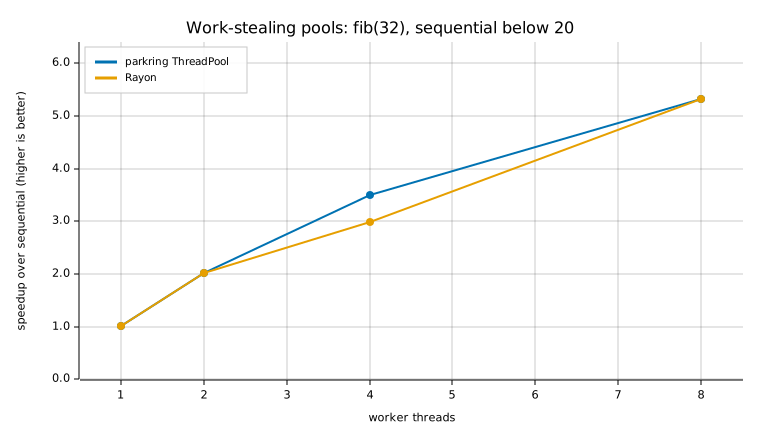
On compute-bound work it scales like Rayon: the same time at 1, 2 and 8 threads, slightly ahead at 4, and **5.3 times faster** than sequential code on 8 threads.

## Benchmarks: The Wins and the Losses

Every number is from one Apple M4 (4 performance and 6 efficiency cores), with worker threads spawned once and reused, so the measurement is the queue and not thread creation. Full tables, method and confidence intervals are in [BENCHMARKS.md](https://github.com/anmol0b/parkring/blob/main/docs/BENCHMARKS.md).

![Throughput scaling](/blog/parkring/mpmc_scaling.svg)

| workload | parkring | best alternative | result |
|---|---|---|---|
| queue, 1 producer + 1 consumer | 91 M items/s | crossbeam: 80 to 85 | parkring faster |
| queue, 2 + 2 up to 16 + 16 | 46 to 62 | crossbeam: 53 to 73 | crossbeam 10 to 17% faster |
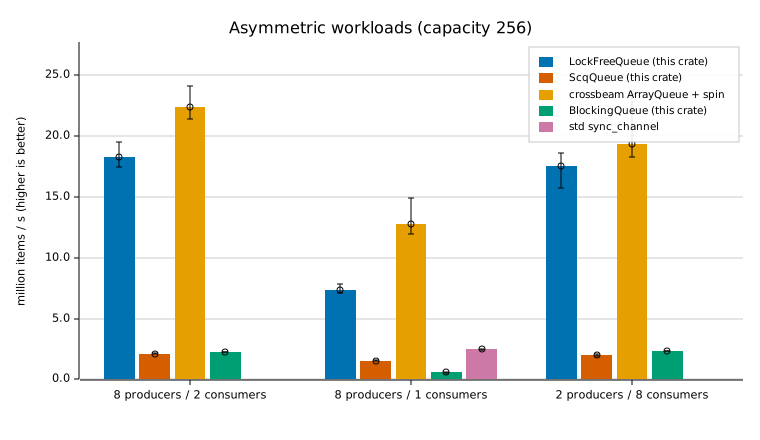
| queue, 8 producers + 1 consumer | 7.4 | crossbeam: 12.8 | crossbeam about 70% faster |
| `ScqQueue` | 7 to 13 | `LockFreeQueue`: 51 to 127 | 5 to 8 times slower |
| deque, one thief draining | 85 | crossbeam-deque: 70 | parkring 21% faster |
| deque, 2 or 4 thieves | 10.5 / 5.5 | crossbeam-deque: 10.5 / 5.7 | level |
| pool, `fib(32)` on 8 threads | 1.36 ms | Rayon: 1.36 ms | level |
| pool, `join` at every level, 8 threads | 582 µs | Rayon: 374 µs | Rayon faster |
| waiting consumer: wake / idle CPU | 9.4 µs / 1.7% | `std::sync::mpsc`: 8.8 µs / 1.3% | level |

![Asymmetric workloads](/blog/parkring/asymmetric.svg)

### So, plainly

- Many producers and consumers at maximum throughput? **crossbeam's `ArrayQueue` is faster.**
- Need `select`, unbounded or zero-capacity channels? **Use `crossbeam-channel` or `flume`.**
- Parallel iterators, or very fine-grained `join` at scale? **Use Rayon.**
- Writing `async` code? parkring blocks threads, so **it isn't for you yet.**

parkring makes sense when you want a small, heavily checked crate whose waiting threads **sleep instead of spin**, with channels, a deque and a pool that share one parking design.

Some things aren't measured yet: the channel against `crossbeam-channel` and `flume`, any x86-64 or Linux machine, and latency percentiles under steady load. They're tracked in [issue #13](https://github.com/anmol0b/parkring/issues/13), and the contention gap with crossbeam is [issue #12](https://github.com/anmol0b/parkring/issues/12).

## What 1.0 Promises

1.0 means the public API is frozen. Breaking changes need a 2.0, and a few decisions were made so that 1.x can grow without breaking anyone:

- **`BoundedQueue` is sealed.** Only parkring's queues implement it, so methods can be added in a minor release.
- **Capacity is "at least" what you ask for.** `capacity()` reports the real size; the exact rounding isn't part of the contract.
- **A default `std` feature.** Building without it is currently an error, so a future `no_std` mode can be added without breaking anyone.
- **MSRV is Rust 1.85**, and raising it is a minor-version change, never a patch.
- **CI tests** Linux, macOS and Windows on stable and beta, plus 32-bit i686 and AArch64 Linux, with a build check on FreeBSD.

The public API is snapshotted in a file and checked on every pull request, along with `cargo-semver-checks` against the last release, so an accidental breaking change fails CI instead of reaching users.

## Final Thoughts

A few things I'll carry into every concurrent project from now on:

- **Write the test that would have caught the bug first.** Every bug in this project has a test that failed before the fix.
- **Make your checker able to check you.** When loom couldn't verify my design, the right move was to change the design, not to silence loom.
- **Break things on purpose.** The four broken builds in CI keep the model checking honest.
- **Use more than one tool.** loom found ordering bugs, Miri found aliasing bugs loom can't see, a plain stress test found a hole in a paper, and reading the code found the unwind hole. No single tool would have found all of them.
- **Publish the losses.** SCQ is slower, and crossbeam beats my queue under contention. Saying so, with the profiling that explains why, is worth more than a table that only shows wins.

If you're learning Rust concurrency, the best way in is still the one I suggested in [Rust Made Simple](/blog/rust-made-simple): **build something small, like a queue.** Then try very hard to break it.

---

parkring 1.0 is on [crates.io](https://crates.io/crates/parkring), the docs are on [docs.rs](https://docs.rs/parkring), and the code is at [github.com/anmol0b/parkring](https://github.com/anmol0b/parkring). Issues and pull requests are welcome, especially benchmarks from x86-64 and Linux machines.
Anmol Bhardwaj

parkring 1.0: Concurrency Primitives I Tried Hard to Break

Oct 8, 2026 · 20 min read · Rust, Concurrency

claps

loom catching a double take in a deliberately broken work-stealing deque

parkring is a Rust crate with bounded channels and queues, a work-stealing deque and a work-stealing thread pool. It started as one small queue that passed all its tests and was still wrong. This post is how it got to 1.0: what each piece does, how it works, and what the tools found along the way, including a hole in a published paper's algorithm.

Code, design notes and every benchmark: github.com/anmol0b/parkring. Docs: docs.rs/parkring.

Introduction:-

Let's start with a simple question:

How do you know concurrent code is correct?

With normal code, you write tests, they pass, and you move on.
With concurrent code, a test can pass ten thousand times and fail on run ten thousand and one. Or only on a different CPU. Or only when the OS pauses a thread at exactly the wrong instruction.

My first queue passed every test I wrote for it. It still lost items, reported "full" when it wasn't, and burned a CPU core while doing nothing.

This post is about what I built after that, and more importantly how I checked it:

  • what a bounded MPMC queue is, and the two classic ways to build one
  • how threads wait without wasting a core
  • channels, a work-stealing deque and a thread pool on top
  • the tools that found real bugs, and the bugs they found
  • benchmarks, including the ones where I lose

The goal is simple:

make every bug something a tool catches, not something luck catches.

cargo add parkring

What's in the box :-

This is the part most people will use, a bounded channel between threads:

use std::thread;
use parkring::channel;

let (tx, rx) = channel::bounded(64);

// Four producers, each with its own clone of the sender.
let producers: Vec<_> = (0..4u64)
    .map(|id| {
        let tx = tx.clone();
        thread::spawn(move || {
            for i in 0..1_000 {
                tx.send(id * 1_000 + i).unwrap(); // sleeps while the channel is full
            }
        })
    })
    .collect();
drop(tx); // only the producers' clones keep the channel open now

// `iter()` ends once all senders are gone and the channel is empty.
let total: u64 = rx.iter().sum();
assert_eq!(total, (0..4_000).sum());
for p in producers {
    p.join().unwrap();
}

Under it sit the pieces that do the real work:

typewhat it isbased on
channel::boundedMPMC channel, disconnects when one side is dropped
LockFreeQueuebounded MPMC queue, spins then sleepsVyukov
ScqQueuebounded MPMC queue with a lock-free guarantee (64-bit)Nikolaev, DISC 2019
BlockingQueuea mutex and two condvars, the reference everything is tested against
Worker / StealerChase-Lev work-stealing dequeLê et al., PPoPP 2013
ThreadPool, joinfork-join pool built on the deque

The only dependency is libc. A thread that has to wait sleeps in the kernel, so an idle program uses no CPU.

The Problem: Many Threads, One Queue

Picture a web server. Some threads accept requests, others process them.

The accepting threads need somewhere to put work.
The processing threads need somewhere to take it from.

That place is a queue, and because many threads put work in and many take it out, it's a multi-producer, multi-consumer (MPMC) queue.

producer 1 ──┐                      ┌──▶ consumer 1
producer 2 ──┼──▶ [ bounded queue ] ┤
producer 3 ──┘                      └──▶ consumer 2

It should be bounded: it holds at most N items, and when it's full, producers wait.

That isn't a limitation, it's the point.

A bounded queue gives you backpressure. If consumers fall behind, producers slow down instead of filling memory until the process dies.

So the job is: a fixed-size buffer that many threads can push to and pop from at once, without losing items, without duplicating them, in FIFO order, and fast.

The Obvious Answer: A Lock

The simplest correct version is a ring buffer behind a mutex, with two condition variables: one wakes producers when space frees up, the other wakes consumers when an item arrives.

pub fn push(&self, item: T) {
    let mut ring = self.lock.lock().unwrap();
    while ring.is_full() {
        ring = self.not_full.wait(ring).unwrap();   // sleep until a pop
    }
    ring.push(item);
    self.not_empty.notify_one();                     // wake a consumer
}

That's BlockingQueue, and it's obviously correct.

Its problem is just as obvious: every push and pop takes the same lock.

With one producer and one consumer, that's fine. With eight of each, threads spend their time waiting for each other. At 4 producers and 4 consumers on a 16-slot queue, it manages about 1 million items a second. The lock-free queue below does 19.5 million on the same test.

Without a Lock: Vyukov's Ring

Dmitry Vyukov's bounded MPMC queue removes the global lock.

The trick is a sequence number in every slot, which says which "turn" the slot is ready for.

 positions:   0    1    2    3  | 4    5    6    7  | ...   (they only ever grow)
 slots:      [s0] [s1] [s2] [s3]  (position p lives in slot p % 4)

 slot.sequence == p      → empty, waiting for the producer of position p
 slot.sequence == p + 1  → full, waiting for the consumer of position p
 after the consumer      → sequence = p + 4: empty for the next lap
  • A producer reads tail, checks that slot's sequence, and claims the position with one compare-and-swap.
  • It writes the item, then publishes it by bumping the sequence.
  • A consumer does the mirror image on head.

Producers and consumers working on different slots never touch the same memory, so they never wait for each other.

Why memory ordering matters here

The CPU and the compiler are both allowed to reorder memory operations. So "write the item, then bump the sequence" is not automatically seen in that order by another core.

The bump is a Release store. The consumer's read is an Acquire load. Together they guarantee that a consumer who sees the new sequence also sees the item.

The whole queue rests on that one pairing.

My First Version, and What Was Wrong With It

My first version had both queues, a mutex one and a Vyukov one, a test suite that passed, and benchmarks. It was published as bounded_mpmc_queue 0.1.

When I came back to turn it into a real library, I audited my own code. It had real bugs.

try_push failed when the queue wasn't full

Vyukov's algorithm compares the sequence with the position three ways:

  • equal → claim it
  • smaller → full
  • larger → someone else got there first, reload and retry

My version treated anything other than equal, and any lost race, as "full":

Err(_) => return Err(item),   // lost a race: reported as full
...
} else {
    return Err(item);          // stale position: reported as full
}

Four threads pushing 8 items each into a 64-slot queue, which never held more than half its capacity, got 65 rejected pushes. The blocking push only worked because it retried blindly.

Capacities that weren't powers of two lost items

The README said capacity was rounded up to a power of two. The code didn't do that, but it indexed with pos & (capacity - 1), which only works for powers of two.

A capacity-3 queue accepted three pushes and then returned none of them.

Idle threads burned a core forever

A consumer waiting on an empty queue spun and yielded in a loop. It had no way to sleep and no way to be told the queue was shutting down.

The benchmarks measured the wrong thing

Every timed iteration spawned up to 32 threads to move 100 items each. The numbers mostly measured thread::spawn.

All of these are fixed, each with a regression test that fails on the original code. Then I set out to make sure the next round of bugs would be caught by tools, not by luck.

Waiting Without Burning a Core: Spin, Then Park

When a queue is empty, a consumer has two bad options:

  • spin: reacts fast, wastes a whole core
  • sleep: cheap, but slow to wake

parkring does both, in order: spin briefly (the item often arrives within microseconds), yield a few times, then park, which puts the thread to sleep in the kernel until someone wakes it.

The lost wakeup

Parking is where concurrency bugs like to hide. The classic one:

consumer                         producer
────────                         ────────
check queue: empty
                                 push item
                                 any sleepers? none yet, skip the wake
go to sleep
   ...sleeps forever, with an item in the queue

The fix is a careful protocol:

  1. The consumer registers as a waiter, then re-checks the queue before sleeping.
  2. The producer publishes the item, then checks for waiters.
  3. The re-check is a read-modify-write on the same atomic the producer changes, so at least one of the two must see the other.

The gap between "re-checked" and "actually asleep" is closed by sleeping on a futex: the kernel only puts the thread to sleep if a word in memory still holds the value the thread last saw. If the producer changed it in between, the sleep doesn't happen.

parkring calls the kernel directly for this: futex(2) on Linux and __ulock on macOS, with a Condvar fallback everywhere else.

Measured with getrusage, a parked consumer uses about 35 to 55 µs of CPU over 300 ms. A spinning one uses all 300 ms.
Wake latency against idle CPU

That chart is the trade-off in one picture. crossbeam's ArrayQueue has no blocking operation, so a waiting consumer has to spin: it notices a new item in 0.3 µs but burns 100% of a core. parkring wakes in about 9 µs, the cost of a kernel wakeup, and uses under 2%, about the same as std::sync::mpsc.

Channels: The Part You'll Actually Use

A shared queue with an explicit close() is a fine building block, but it puts shutdown on you. Somebody has to know when the last producer is done and call close exactly once.

Channels move that job to the type system. channel::bounded(n) returns a Sender and a Receiver, both cloneable, and the channel closes itself when the last handle on either side is dropped:

  • Drop the last Sender → receivers still get every message that was sent. After that, recv returns Err(RecvError) and iter() ends.
  • Drop the last Receiver → send fails at once and hands your message back inside SendError, so nothing is silently lost.
use parkring::channel::{self, TrySendError};

let (tx, rx) = channel::bounded(2);
tx.try_send("a").unwrap();
tx.try_send("b").unwrap();
assert_eq!(tx.try_send("c"), Err(TrySendError::Full("c"))); // full: nothing waits

assert_eq!(rx.recv(), Ok("a"));
drop(rx); // the only receiver
assert_eq!(tx.send("d").unwrap_err().into_inner(), "d"); // you get "d" back

Underneath, a channel is a LockFreeQueue plus two counters, one for live senders and one for live receivers. Whoever drops a count from one to zero closes the queue. The names (try_send, recv_timeout, TryRecvError and so on) follow std::sync::mpsc and crossbeam-channel, so it should feel familiar.

The tricky part is the race between the last sender dropping and a receiver going to sleep. If the receiver checks "anyone still sending?", then the sender drops and closes, and only then does the receiver park, it must still wake up.

That's the same shape as the lost wakeup above, and it gets the same treatment.

loom models of the disconnect races run under both parkers, and a deliberately broken build that skips the close (channel_no_disconnect) must be caught by loom, or CI fails.

How Do You Test This?

Concurrency bugs depend on timing, so parkring is checked by several tools, each blind in a different place.

Ordinary tests, repeated

Every queue runs the same suite: FIFO order, exactly-once delivery across many producer and consumer counts, shutdown, timeouts. The concurrent tests run in loops, because rare schedules only show up under repetition.

Property-based tests

proptest generates thousands of random operation sequences and checks each queue against an obviously correct model, Rust's VecDeque. When one fails, it shrinks the input to the smallest failing case.

loom, a model checker

loom runs a test under every possible interleaving of its threads, up to a bound, and models the C++/Rust memory model, including which stale values a load is allowed to return.

A loom test isn't "probably fine". Within its bound, it has tried every schedule.

Miri, an interpreter for undefined behaviour

Miri runs the tests on an interpreter that checks every pointer, every read of possibly uninitialised memory, every data race and Rust's aliasing rules. parkring runs it under both aliasing models (stacked borrows and tree borrows), with both parkers, and with 16 different scheduling seeds per test for the channel and the Vyukov queue.

Fuzzing

cargo-fuzz drives the queues, the deque (including index wraparound) and the channel with arbitrary operation sequences and compares them with sequential models. Each target gets a minute on every pull request and fifteen minutes every night.

ThreadSanitizer

TSan watches the queue and channel tests for data races with real threads on real hardware.

Two rules that hold it together

1. The code loom checks is the code that ships. Every atomic, mutex and condvar in the crate goes through one small module that swaps in loom's versions when model checking, and CI fails if any code bypasses it.

2. Break things on purpose. A checker that has never been seen to fail proves very little. So CI also builds four deliberately broken versions of the crate (two missing fences in the deque, a weakened SCQ threshold, and the channel that never disconnects) and requires loom to catch every one.

What the Tools Found

This is the part I'm proudest of. Each one was a real bug or a real gap.

1. A capacity-1 queue overwrote live items

In a one-slot ring, "full for this lap" and "empty for the next lap" have the same sequence number, so a producer could overwrite an item nobody had read.

The drop-accounting tests (a type that counts its constructions and destructions) caught it, and proptest independently shrank its failure to exactly capacity = 1. Vyukov's original code requires at least two slots for this reason. Mine does now too.

2. A parking protocol loom couldn't verify

My first lost-wakeup argument used SeqCst operations, and it's correct under the C++ memory model. But loom treats SeqCst loads and stores as weaker acquire/release operations, so it reported a deadlock it couldn't rule out.

I could have silenced it. Instead I re-derived the protocol on read-modify-write operations and release sequences, which loom does model. loom now verifies it, and the fast path got cheaper as a side effect.

Then I broke it on purpose: moving one load after the re-check makes loom report the deadlock. That shows the test checks exactly the property the argument depends on.

3. My futex parker was slower than the mutex it replaced

The first version called the kernel's wake function whenever any thread was registered as a waiter. Under load, that meant a system call on almost every operation.

Counting only threads that are actually asleep fixed it, at the cost of a second race, which two memory fences close. Remove either fence and loom deadlocks.

4. A hole in a published algorithm

More on this in the SCQ section below.

5. The textbook work-stealing bug

The Chase-Lev deque needs two SeqCst fences. Build it without either one and loom finds the schedule where two threads take the same element:

assertion `left == right` failed: an element was taken twice: [0, 1, 1]

That's the screenshot at the top of this post. Those two broken builds are among the four CI requires loom to catch. If a refactor ever made loom stop noticing, CI would go red.

6. Two aliasing violations only Miri could see

When the deque grows, the old buffer is retired, but a thief may still be reading it. My first version turned the retired pointer back into a Box, which under Rust's aliasing rules claims unique ownership while another thread is reading.

Later, the thread pool's latch held a &self reference that stayed "protected" for the whole function call, while the waiting thread freed the memory as soon as it saw the flag.

loom can't see either one, because it checks memory orderings, not aliasing. Miri caught both, and the second only showed up in CI, on a scheduling seed I hadn't run locally.

7. An unwind that could free memory another thread was using

This one came from reading the code before 1.0, not from a tool, and it's the one I'm gladdest to have found before anyone depended on the crate.

To avoid allocating, join(a, b) keeps job b in its own stack frame while another thread may steal and run it. User panics were already caught and passed back safely. But if something inside parkring panicked in that window (an internal expect, an unreachable!), the frame would unwind and be freed while a thief was still writing into it.

Now an AbortOnUnwind guard is armed before the job is shared and disarmed only once its result is back, so that case aborts the process instead, as Rayon does. install has the same guard, and a worker thread clears its thread-local pointer if it unwinds.

Every unsafe block and the argument for why it's sound is listed in UNSAFE.md, including the weak spots I know about.

SCQ: A Lock-Free Queue From a 2019 Paper

Vyukov's queue has one subtle weakness: it isn't lock-free in the formal sense. If the OS pauses a producer between claiming a slot and publishing it, the consumer of that slot has to wait until the producer runs again.

Nikolaev's SCQ ("A Scalable, Portable, and Memory-Efficient Lock-Free FIFO Queue", DISC 2019) fixes that with a different design:

  • positions are claimed with fetch_add, which never fails
  • a consumer that finds an unpublished slot invalidates it after a short wait, so the producer just takes another position
  • no operation ever waits on one particular thread
push:  take a free index from fq → write the data cell → enqueue the index on aq
pop:   dequeue an index from aq  → read the data cell  → return the index to fq

The hole

The paper uses a threshold counter to stop consumers from spinning past an empty queue forever.

A stress test with capacity 1, three producers and three consumers hung in 11 of 40 runs. Dumping the queue's state at the hang showed an item sitting at exactly the next position to dequeue, with the threshold at -1, so every consumer gave up before looking at it.

The paper's bound counts positions. It doesn't count consumers that claimed a position before the threshold was reset and decremented it after, and how many of those there can be depends on the number of threads, not the capacity.

The reference implementation is benchmarked with 65,536-slot rings, where a few threads can never use up the threshold. With one slot, six threads can.

The fix treats the threshold as a hint and never trusts it while tail > head. The test now passes 60 runs out of 60, and a regression test runs the scenario 200 times with a watchdog.

Then the honest part

SCQ is slower here, by a lot. On my 10-core Apple M4 it's 5 to 8 times slower than the Vyukov queue.

Profiling found two self-inflicted costs, one of them consumers reading the producers' counter on every operation, which bounced a cache line between cores. Fixing them was worth about 1.7×. The rest is structural: every item touches two index rings and a data cell, and on ARM a retried CAS is cheap, so Vyukov's retries cost less than SCQ's extra work.

SCQ earns its place with its progress guarantee, and the docs say so rather than pretending it wins.

A Work-Stealing Deque and a Thread Pool

The last two pieces are the machinery behind Rayon and Tokio.

The deque

A work-stealing deque has one owner and many thieves.

  • The owner pushes and pops at one end, like a stack. Fast and cache-friendly.
  • When another thread runs out of work, it steals from the other end and takes the oldest task.
              ┌──────┬──────┬──────┬──────┐
 thieves ◀──  │ old  │      │      │ new  │  ◀──▶ owner
 steal oldest └──────┴──────┴──────┴──────┘       push / pop newest

The famous difficulty is the last element: the owner pops while a thief steals at the same moment. The original 2005 algorithm assumes a sequentially consistent machine, and on real hardware it can hand the same task to both. That's exactly the bug loom reproduces above.

parkring uses the orderings Lê et al. proved correct in 2013, adapted to today's C++/Rust rules.

The pool

The thread pool puts it all together:

  • each worker owns a deque
  • jobs from outside arrive through a parkring queue
  • idle workers park on the futex

join(a, b) pushes b, runs a, and then runs b itself unless another worker stole it. Its bookkeeping lives on the caller's stack, so a join never allocates (which is exactly why bug 7 above mattered).

fn fib(n: u64) -> u64 {
    if n < 20 { return fib_sequential(n); }
    let (a, b) = parkring::join(|| fib(n - 1), || fib(n - 2));
    a + b
}
Pool scaling against Rayon

On compute-bound work it scales like Rayon: the same time at 1, 2 and 8 threads, slightly ahead at 4, and 5.3 times faster than sequential code on 8 threads.

Benchmarks: The Wins and the Losses

Every number is from one Apple M4 (4 performance and 6 efficiency cores), with worker threads spawned once and reused, so the measurement is the queue and not thread creation. Full tables, method and confidence intervals are in BENCHMARKS.md.
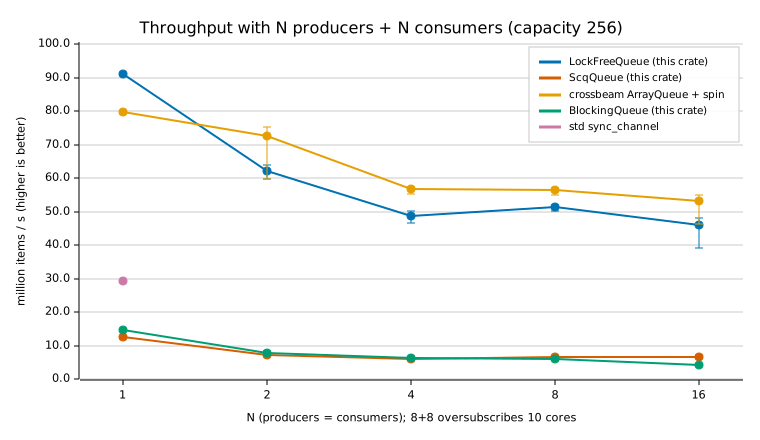
Throughput scaling

workloadparkringbest alternativeresult
queue, 1 producer + 1 consumer91 M items/scrossbeam: 80 to 85parkring faster
queue, 2 + 2 up to 16 + 1646 to 62crossbeam: 53 to 73crossbeam 10 to 17% faster
queue, 8 producers + 1 consumer7.4crossbeam: 12.8crossbeam about 70% faster
ScqQueue7 to 13LockFreeQueue: 51 to 1275 to 8 times slower
deque, one thief draining85crossbeam-deque: 70parkring 21% faster
deque, 2 or 4 thieves10.5 / 5.5crossbeam-deque: 10.5 / 5.7level
pool, fib(32) on 8 threads1.36 msRayon: 1.36 mslevel
pool, join at every level, 8 threads582 µsRayon: 374 µsRayon faster
waiting consumer: wake / idle CPU9.4 µs / 1.7%std::sync::mpsc: 8.8 µs / 1.3%level

Asymmetric workloads

So, plainly

  • Many producers and consumers at maximum throughput? crossbeam's ArrayQueue is faster.
  • Need select, unbounded or zero-capacity channels? Use crossbeam-channel or flume.
  • Parallel iterators, or very fine-grained join at scale? Use Rayon.
  • Writing async code? parkring blocks threads, so it isn't for you yet.

parkring makes sense when you want a small, heavily checked crate whose waiting threads sleep instead of spin, with channels, a deque and a pool that share one parking design.

Some things aren't measured yet: the channel against crossbeam-channel and flume, any x86-64 or Linux machine, and latency percentiles under steady load. They're tracked in issue #13, and the contention gap with crossbeam is issue #12.

What 1.0 Promises

1.0 means the public API is frozen. Breaking changes need a 2.0, and a few decisions were made so that 1.x can grow without breaking anyone:

  • BoundedQueue is sealed. Only parkring's queues implement it, so methods can be added in a minor release.
  • Capacity is "at least" what you ask for. capacity() reports the real size; the exact rounding isn't part of the contract.
  • A default std feature. Building without it is currently an error, so a future no_std mode can be added without breaking anyone.
  • MSRV is Rust 1.85, and raising it is a minor-version change, never a patch.
  • CI tests Linux, macOS and Windows on stable and beta, plus 32-bit i686 and AArch64 Linux, with a build check on FreeBSD.

The public API is snapshotted in a file and checked on every pull request, along with cargo-semver-checks against the last release, so an accidental breaking change fails CI instead of reaching users.

Final Thoughts

A few things I'll carry into every concurrent project from now on:

  • Write the test that would have caught the bug first. Every bug in this project has a test that failed before the fix.
  • Make your checker able to check you. When loom couldn't verify my design, the right move was to change the design, not to silence loom.
  • Break things on purpose. The four broken builds in CI keep the model checking honest.
  • Use more than one tool. loom found ordering bugs, Miri found aliasing bugs loom can't see, a plain stress test found a hole in a paper, and reading the code found the unwind hole. No single tool would have found all of them.
  • Publish the losses. SCQ is slower, and crossbeam beats my queue under contention. Saying so, with the profiling that explains why, is worth more than a table that only shows wins.

If you're learning Rust concurrency, the best way in is still the one I suggested in Rust Made Simple: build something small, like a queue. Then try very hard to break it.


parkring 1.0 is on crates.io, the docs are on docs.rs, and the code is at github.com/anmol0b/parkring. Issues and pull requests are welcome, especially benchmarks from x86-64 and Linux machines.

claps

Comments